
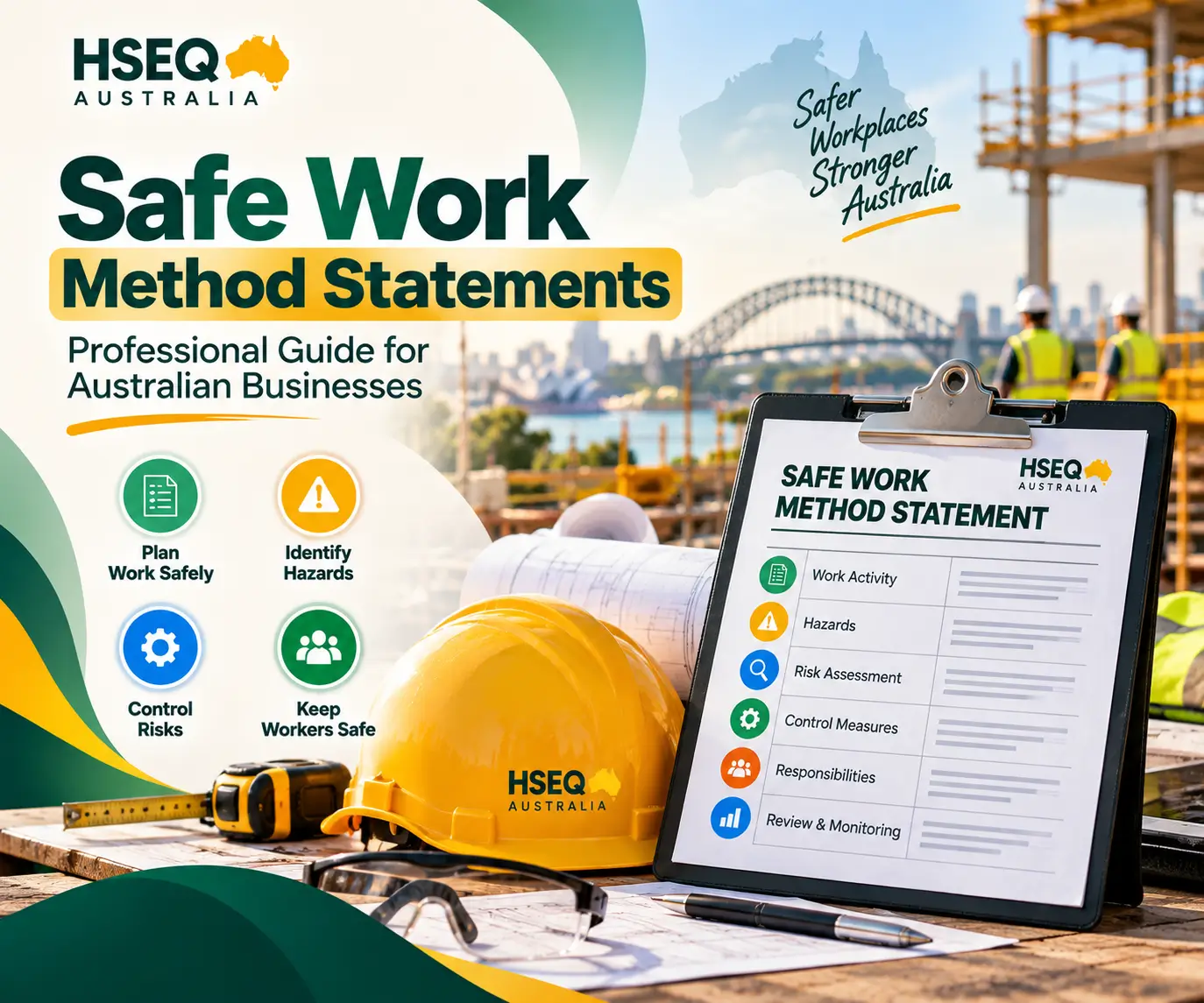
Need a clear way to manage high-risk work on an Australian worksite? Safe work method statements help workers understand the job, identify hazards, follow safety controls, and carry out high-risk construction work in a planned way. HSEQ Australia helps businesses develop practical safety documentation that reflects their actual worksite, risks, and WHS requirements. It also helps businesses meet their WHS duties before work begins. For Perth businesses, using practical documents that match the real site matters because tasks, equipment, workers, and conditions can change from one project to another.
What Are Safe Work Method Statements?
A Safe work method statements is a written document for high-risk construction work. It describes the work, the hazards and risks linked to it, the controls used to manage those risks, and how those controls will be put into place, monitored, and reviewed. Safe Work Australia states that a PCBU carrying out high-risk construction work has duties to prepare, keep, comply with, and review the SWMS.
Understanding SWMS for Australian Workplaces
A good SWMS is more than a form stored in a project folder. Workers should be able to read it, understand the required steps, and use it while completing the task. It should match the actual workplace, equipment, work sequence, and risks instead of relying on broad safety wording. Regular safety audit services can also help businesses review whether their SWMS and other workplace safety processes are being followed effectively.
SWMS vs Risk Assessment Documents
A risk assessment helps identify hazards, assess risk, and select controls. A SWMS focuses on high-risk construction work and explains how those controls will be applied during the job.
Businesses may also use safe work procedures, WHS management plans, risk registers, emergency plans, and training records. Each document has a different role within the wider safety system.
Why SWMS Matter in Construction
Construction sites can change quickly as workers, plant, contractors, materials, and work stages move through the site. A useful SWMS gives workers and supervisors a clear reference for the high-risk activities they are about to perform.
Expert Guide to SWMS Requirements
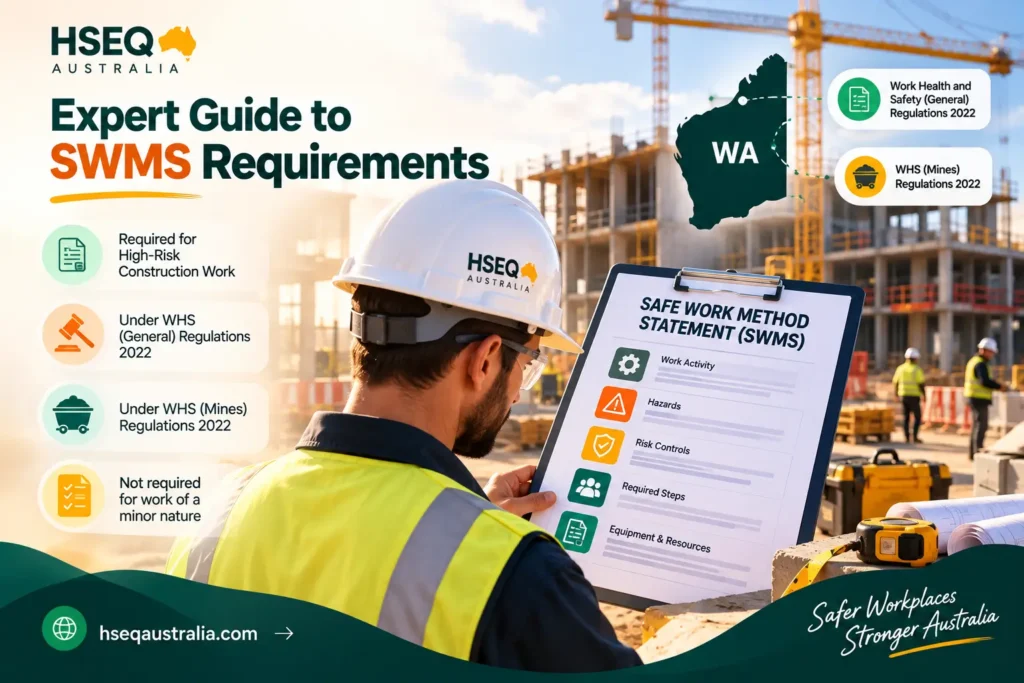
A safe work method statement is required before high-risk construction work starts. In Western Australia, WorkSafe states that the Work Health and Safety (General) Regulations 2022 and WHS (Mines) Regulations 2022 require an SWMS for proposed high-risk construction work before any activity begins. WorkSafe WA also notes that an SWMS is not required for work of a minor nature.
When Is a SWMS Required?
The requirement applies to high-risk construction work rather than every task performed on a construction site.
Examples include work involving:
- A risk of a person falling more than 2 metres
- Confined spaces
- Trenches or shafts deeper than 1.5 metres
- Energised electrical services
- Pressurised gas or chemical lines
- Powered mobile plant
- Roads, railways, or other traffic corridors
- Demolition or structural work
- Asbestos
- Tilt-up or precast concrete
- Work near water with a drowning risk
Safe Work Australia lists 18 categories of high-risk construction work under the model WHS framework. State and territory rules should be checked for the location of the project.
High-Risk Construction Work and SWMS
The document should focus on the HRCW activity being performed. It does not need to become a long collection of every safety document used by a business. WorkSafe WA says a SWMS should identify the HRCW, hazards and risks, control measures, and how those controls will be implemented, monitored, and reviewed. It also says the document should be short enough for workers to understand and apply.
Understanding Australian WHS Requirements
Australian WHS laws are not identical in every jurisdiction. For example, Victoria uses its Occupational Health and Safety Regulations, while Western Australia operates under the WHS Act 2020 and WHS regulations. Businesses should check the regulator for the state or territory where the work takes place.
For WA businesses, WorkSafe has also confirmed that regulation 79, covering specific requirements for minimising fall risks, takes effect for high-risk construction work from 1 October 2026.
What Makes the Best SWMS?
A strong SWMS makes the planned work easy to follow. It connects each task with its hazards, controls, responsibilities, and review process.
Essential Details Every SWMS Should Include
Include the project and site details, the relevant HRCW activity, the work tasks, hazards, risks, control measures, responsible people, and the process for monitoring and review. WorkSafe Victoria also advises identifying the specific task, hazard, control measures, and person responsible for implementing those controls.
Identifying Workplace Hazards and Risks
Look at each stage of the work and ask what could cause harm. Depending on the task, this may include falls, moving plant, electrical services, unstable ground, traffic, hazardous substances, manual handling, or interaction with other contractors.
Choosing Effective Safety Control Measures
Controls should be practical and linked to the real hazard. Use the hierarchy of control, starting with eliminating the risk where reasonably practicable, then considering options such as substitution, isolation, engineering controls, administrative controls, and PPE.
Including PPE, Equipment and Worker Duties
The SWMS should identify the equipment used and the responsibilities of workers, supervisors, operators, or other people involved. PPE may be one part of the controls, but it should not replace stronger controls where those controls are reasonably practicable.
Professional Steps to Write a SWMS
Preparing safe work method statements works best when you build it around the actual job rather than filling in a generic form without checking the site.
Identify the Job and Worksite
Start with the project, location, work activity, people involved, equipment, and site conditions. Check access, ground conditions, nearby services, other trades, traffic, and any conditions that may change the work.
Break the Work Into Steps
Write the job in the order workers will perform it. Clear steps make it easier to connect each activity with the hazards and controls that apply.
Identify Hazards for Each Task
Look at every work step and identify the hazards that could cause injury or harm. Avoid copying unrelated hazards from an old document.
Assess Risks and Select Controls
Consider the level of risk and choose controls that fit the work. The controls should explain what needs to happen, not simply say “work safely” or “use appropriate PPE.”
Assign Responsibilities to Workers
State who will put each control in place and who will check it. Clear responsibility helps supervisors and workers understand their role.
Review the SWMS Before Work
Review the document when the work, site conditions, equipment, risks, or controls change. SafeWork NSW says a SWMS must take site conditions into account and be reviewed when changes affect the work.
Best Safe Work Method StatementsTemplates for Australian Businesses
A SWMS template can save time and help keep documents consistent. Government regulators provide templates that can be used as a starting point. WorkSafe Victoria provides a template with guidance for HRCW, control measures, responsibilities, and preparation.
What a Good Safe Work Method StatementsTemplate Includes
Look for sections covering the work activity, hazards, risks, control measures, responsibilities, implementation, monitoring, and review.
Free Templates vs Professional SWMS
A free template may work well as a starting document for routine work. A professional service can be useful when the project has complex hazards, client requirements, multiple contractors, or site conditions that need closer review.
Generic Templates vs Site-Specific SWMS
SafeWork NSW allows generic SWMS for regular high-risk activities, but the document still needs to be reviewed for the site-specific hazards and risks. One SWMS can also cover several HRCW activities when appropriate.
Affordable Safe Work Method Statements Solutions for Businesses
Cost matters, but the cheapest document may not suit the job. The amount of work needed can depend on the type of project, hazards, number of tasks, client requirements, site conditions, and level of review required.
What Affects Professional Safe Work Method Statements Costs?
A simple task with known risks may need less preparation than a complex project with several high-risk activities. Additional review, site information, consultation, and document updates can also affect the overall cost.
When Should You Hire an Expert?
Professional support can be useful when your team lacks time, when the work involves several hazards, or when a client requires clear HSEQ documentation before mobilisation.
Are Generic SWMS Documents Enough?
They may provide a useful starting point, but a generic document should not replace checking the actual job. Site conditions, work methods, equipment, and other activities can change the controls needed.
Top Rated Safe Work Method Statements Support in Perth
Choosing a provider should be based on more than a template design. A good provider should understand the work, the site risks, Australian WHS requirements, and the needs of workers and supervisors.
What to Look for in a Provider
Check the provider's experience with your industry, ability to create or review site-specific documents, understanding of HRCW, and approach to worker communication.
Choosing an Expert SWMS Provider
Ask how the provider gathers project information, identifies hazards, checks controls, and handles revisions when work changes.
Questions to Ask Before Hiring
Ask whether the SWMS matches your exact task, how updates are handled, who reviews the document, and how the document will support your existing HSEQ system.
HSEQ Australia provides Safe Work Method Statements review, site risk assessments, hazard checks, safety inspections, and WHS documentation support for Perth businesses and Australian workplaces.
Best SWMS Examples for Construction Work
Examples can help workers understand how a SWMS should connect the work step, hazard, risk, and control.
| Work step | Hazard | Risk | Control |
|---|---|---|---|
| Prepare work area | Site access | Trips or contact with hazards | Establish safe access and work zones |
| Operate plant | Moving equipment | Collision or crush injury | Use trained operators and exclusion zones |
| Perform high-risk task | Task-specific hazard | Injury or exposure | Apply planned controls for the activity |
| Finish work | Poor housekeeping | Trips or blocked access | Clean, inspect, and secure the area |
The exact controls must match the actual work. A sample SWMS should guide preparation, not replace site-specific planning.
Common Professional Safe Work Method Statements Mistakes to Avoid
Using Generic Information for Every Site
A document copied from another project may miss local hazards, equipment, access conditions, or interaction with other work.
Missing Hazards or Safety Controls
Every relevant HRCW step should have clear hazards and practical controls. Vague wording can make the document hard to use.
Failing to Update the SWMS
Review the document when work changes, controls are no longer suitable, or an incident or new hazard shows that changes are needed.
Giving Workers Unclear Safety Instructions
WorkSafe WA says SWMS information must be easily understood by workers. Pictures or diagrams may also help where they communicate the work more clearly.
SWMS Requirements Across Australian States
The core purpose of a SWMS is similar, but the legal framework differs between jurisdictions.
SWMS Requirements in Western Australia
WA businesses should work from the Work Health and Safety Act 2020 and WHS regulations that apply to the project. WorkSafe WA provides a dedicated HRCW SWMS information sheet and template.
SWMS Requirements in New South Wales
SafeWork NSW states that the SWMS must be site-specific, available to workers, supervisors, and other relevant people, and prepared before HRCW begins.
SWMS Requirements in Victoria and Queensland
Businesses should use the current regulator guidance for the state where work occurs. Requirements and terminology can differ, so relying on an old document from another state may create gaps.
Frequently Asked Questions About SWMS
What Is a Safe Work Method Statement?
It is a document that explains high-risk construction work, the hazards and risks involved, and the controls used to manage those risks.
When Is a SWMS Required?
It is required before high-risk construction work begins, subject to the WHS rules that apply in the relevant jurisdiction.
Who Is Responsible for Preparing SWMS?
The PCBU carrying out HRCW must ensure a suitable SWMS is prepared. Other PCBUs may prepare it where agreed, but the duties still need to be managed correctly.
Can You Use a Free SWMS Template?
Yes, as a starting point. The template still needs to reflect the actual site, hazards, risks, controls, and work activities.
Does Every Construction Job Need SWMS?
No. The requirement is tied to high-risk construction work. Other construction work still requires proper risk management under WHS duties.
How Often Should SWMS Be Reviewed?
Review it whenever the work or site changes, controls are not working as planned, or an incident or new hazard shows that the document needs updating.
Can One SWMS Cover Multiple Tasks?
Yes. One document can cover multiple HRCW activities when it properly addresses each activity and the ways those activities may affect one another.
Professional SWMS Support for Your Business
A clear safe work method statement should match the real work, not just fill a document requirement. When hazards, controls, responsibilities, and review steps are easy to understand, workers have a clearer reference for high-risk tasks.
For Perth businesses, HSEQ Australia can support SWMS reviews, site risk assessments, safety documentation, and project HSEQ requirements. Its project support services also include SWMS/JSA development and alignment with project scope. For practical site safety services, speak with HSEQ Australia about the requirements of your project and worksite.
