
A WHS management system gives Australian businesses a structured way to manage workplace health and safety. It brings risk management, worker consultation, training, procedures, incident reporting and safety records into one connected process.
Instead of treating safety as a collection of separate documents, businesses can use a structured safety framework to set responsibilities, control workplace risks and review whether safety measures are working. HSEQ Australia helps businesses understand and implement practical approaches to workplace health and safety. This guide explains what a WHS system includes, how it differs from a WHS management plan, and how businesses can set one up.
What Is a WHS Management System?
A management system is a structured framework of policies, procedures, responsibilities and processes used to manage health and safety across a workplace.
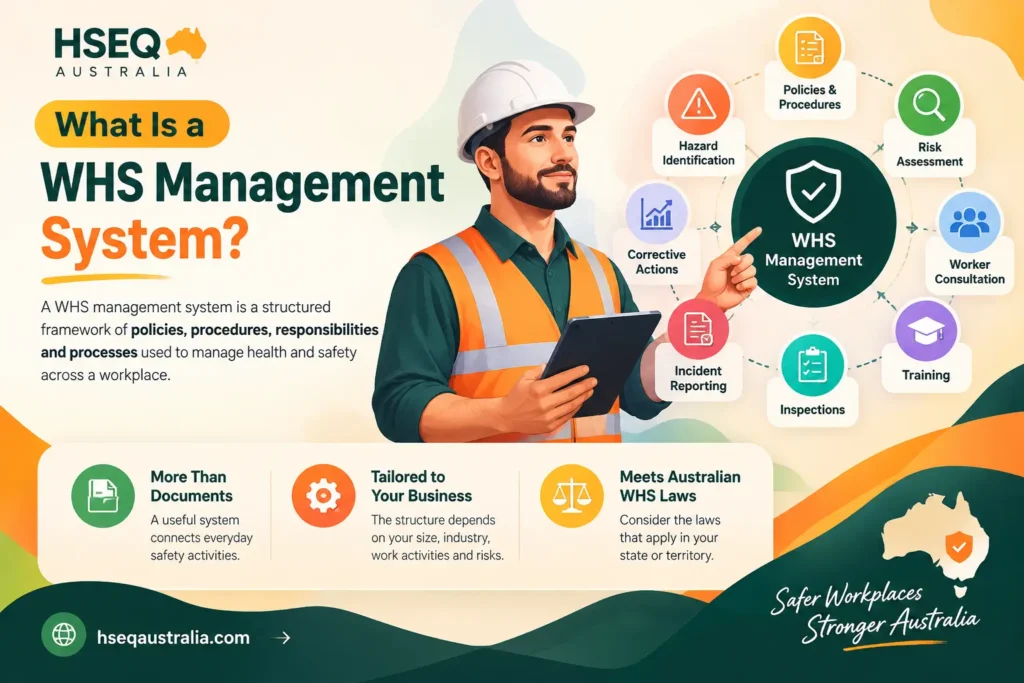
It is more than a folder of safety documents. A useful system connects everyday activities such as hazard identification, risk assessment, worker consultation, training, inspections, incident reporting and corrective actions.
The exact structure depends on the size of the business, its industry, work activities and the risks workers may face. Australian WHS duties also vary between states and territories, so businesses need to consider the laws that apply to their operations.
What Is the Purpose of a WHS Management System?
The purpose is to make workplace safety a planned part of normal business operations.
A good safety framework helps a business identify hazards before they cause harm, decide how risks should be controlled, give workers suitable information and training, and check whether controls remain effective.
For example, a construction business may use its safety processes to manage:
- Site inspections
- Worker and contractor inductions
- High-risk construction work
- Plant and equipment
- Personal protective equipment
- Emergency procedures
- Hazard reporting
- Incident investigations
- Corrective actions
- Worker consultation
Safe Work Australia's risk management guidance supports a systematic process of identifying hazards, assessing risks where necessary, implementing suitable controls and reviewing their effectiveness.
What Are the Key Elements?
A practical brings related safety activities together so that responsibilities and processes are clear.
| Element | What it covers |
|---|---|
WHS policy | The organisation's commitment to workplace health and safety |
Roles and responsibilities | Who manages and performs specific safety tasks |
Hazard identification | Finding hazards connected with work activities |
| Risk management | Assessing risks and selecting suitable controls |
Worker consultation | Giving workers opportunities to contribute to safety decisions |
Training and competency | Providing suitable information, instruction, training and supervision |
Incident management | Reporting, investigating and responding to incidents |
Emergency planning | Preparing for foreseeable workplace emergencies |
Documentation | Maintaining relevant policies, procedures, forms and records |
Inspections and audits | Checking how safety processes operate |
Corrective actions | Recording and addressing identified issues |
Review and improvement | Checking results and updating the system when needed |
Worker consultation is an important part of this structure. Businesses should provide workers, and health and safety representatives where relevant, with opportunities to contribute to WHS matters that affect them.
What Does It Include?
The documents and processes will differ between businesses, but common examples include:
- WHS policies
- Risk management procedures
- Hazard and risk registers
- Safe work procedures
- Safe Work Method Statements where applicable
- Emergency response plans
- Incident reporting forms
- Training and competency records
- Consultation records
- Workplace inspection checklists
- Contractor management procedures
- Plant and equipment registers
- Corrective action registers
- Audit records
The goal is not to create paperwork for its own sake. Each document should support an actual workplace process.
For example, a risk register should help the business track hazards, controls and review actions. A training record should show what workers have been trained to do. A corrective action register should make it easier to track issues until the required action is completed.
WHS Management System vs WHS Management Plan
A WHS management plan is related, but they serve different purposes.
A management system provides the broader structure used to manage health and safety across an organisation. It can cover policies, responsibilities, risk processes, consultation, training, incident management, monitoring and review.
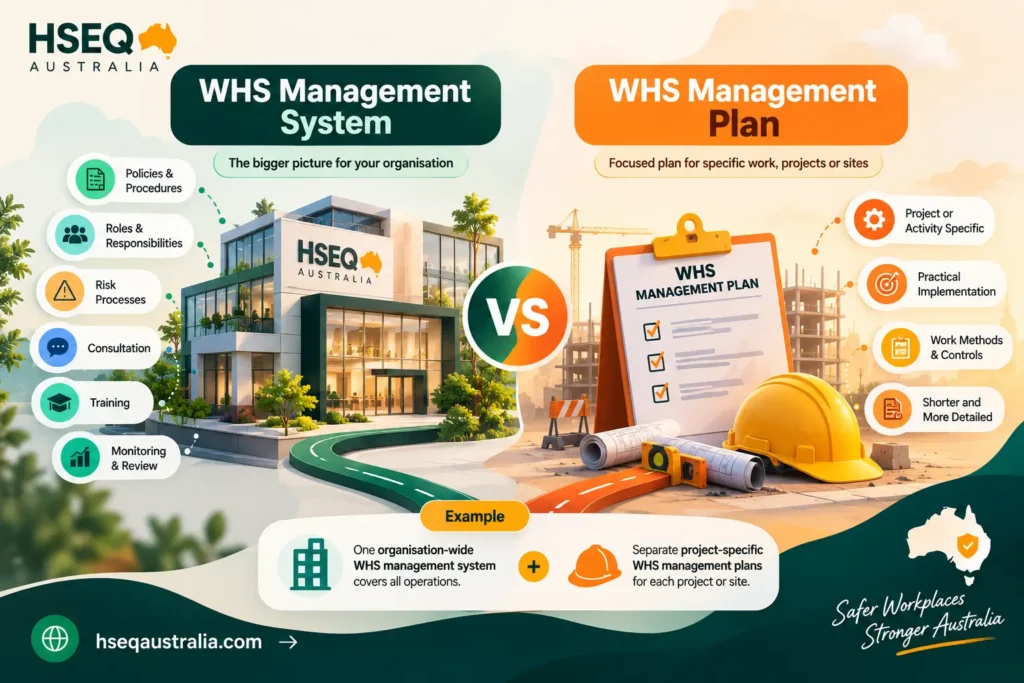
A WHS management plan is generally more specific. It can explain how safety will be managed for particular work, projects, sites or activities. For example, a construction company may have one organisation-wide safety system and separate project-specific management plans.
This distinction is useful because a single plan does not necessarily represent the entire safety system. The plan may sit within a wider set of policies, procedures, registers and workplace processes.
How to Implement One
Setting up does not mean creating every document at once. Start with the work your business actually performs and the risks connected with those activities.
1. Identify Your WHS Duties and Work Activities
Start by identifying the WHS requirements that apply to your business, locations, workers and activities.
Then map the main work processes. Consider equipment, substances, workplace conditions, contractors, changes to work and foreseeable emergencies.
This gives you a practical starting point instead of building your safety processes around generic templates.
2. Identify Hazards and Manage Risks
Look at how work is performed and identify hazards that could cause injury or illness.
A basic risk management process involves:
- Identifying hazards.
- Assessing risks where necessary.
- Selecting suitable control measures.
- Implementing those controls.
- Checking whether the controls work.
- Reviewing controls when circumstances change.
The controls should reflect the actual workplace rather than simply copying a standard template.
3. Consult Workers
Workers can provide useful information about how tasks are performed in practice.
Consult workers when identifying hazards, assessing risks, selecting controls and considering changes that may affect health and safety. Consultation should give workers a reasonable opportunity to raise concerns and contribute to decisions.
4. Create the Required Documentation
Once the main risks and processes are clear, develop the policies, procedures, registers and forms that support them. Keep documents easy to understand and make sure workers can access the information they need.
5. Provide Training and Supervision
Workers need suitable information, instruction, training and supervision for their work. Training should cover the tasks, equipment, hazards and controls relevant to each role. It should also be reviewed when work methods, equipment or identified risks change.
6. Monitor and Review the System
A management system should not stay unchanged after implementation. Use workplace inspections, incident information, consultation feedback, audits and corrective actions to see where improvements are needed. Review controls when there are changes to work, new hazards, incidents or other relevant circumstances.
WHS Management System and ISO 45001
ISO 45001:2018 is an international standard that specifies requirements for an occupational health and safety management system. It covers areas including leadership, worker participation, hazard identification, risk management, legal requirements, emergency planning, auditing and continual improvement.
An Australian business can use ISO 45001 as a framework, but having a WHS system does not automatically mean the business is ISO 45001 certified.
As of September 2026, ISO 45001:2018 remains the current published edition. ISO is developing a revised edition, with ISO/DIS 45001 currently under development.
ISO 45002:2023 also provides general guidance for implementing, maintaining and improving an occupational health and safety management system based on ISO 45001:2018.
For Australian businesses, ISO 45001 can provide a useful management framework, but organisations still need to address the WHS legal requirements that apply to their specific operations.
What Are the Benefits?
A well-designed can give a business a consistent way to manage workplace health and safety.
Potential benefits include:
- Clearer safety responsibilities
- Better visibility of workplace hazards
- More consistent risk controls
- Better worker consultation
- Easier access to safety records
- More organised incident reporting
- Better tracking of corrective actions
- Stronger emergency preparedness
- A structured process for reviewing safety performance
The benefits depend on how the system operates in daily work. Policies and templates alone do not guarantee effective safety management.
WHS Management System Example
Consider a manufacturing business that identifies a machinery hazard.
Its process could look like this:
Hazard identified → risk assessed → controls selected → workers consulted → procedure updated → workers trained → machinery inspected → results monitored → controls reviewed.
Each stage connects with the next. If an incident or near miss occurs, the business can review the relevant records, check existing controls and decide what further action is required.
This makes safety management an ongoing process rather than a document completed once.
Frequently Asked Questions
Is a WHS Management System Required in Australia?
Australian WHS laws place duties on businesses and other duty holders to manage health and safety risks. The specific requirements depend on the applicable state or territory laws, the organisation and its activities.
What Does WHSMS Mean?
WHSMS means Work Health and Safety Management System. It describes the policies, processes, responsibilities and practices an organisation uses to manage workplace health and safety.
What Are the Main Components?
Common components include WHS policies, risk management, worker consultation, training, incident management, emergency planning, safety records, inspections, audits, corrective actions and system reviews.
What Is the Difference Between WHS and OHS?
WHS and OHS both refer to workplace health and safety. WHS is the terminology used in Australia's model WHS laws, while OHS remains a term used in some jurisdictions, organisations and international contexts.
Is ISO 45001 the Same as a WHS Management System?
No. ISO 45001 is an international standard containing requirements for an occupational health and safety management system. An organisation can have its own WHS system without being ISO 45001 certified.
How Often Should the System Be Reviewed?
There is no single review period that suits every business. Reviews should consider changes to work, equipment, hazards, controls, legislation and other relevant circumstances. Businesses can also use planned inspections, audits and management reviews to check performance.
Build a WHS Management System That Fits Your Business
A WHS management system gives an Australian business a structured way to manage workplace health and safety through risk management, worker consultation, training, documentation, incident management and regular review.
The system should reflect the work your people actually perform and the risks they may face. Clear responsibilities, practical procedures and regular review make it easier to keep safety processes active rather than leaving them in a document folder.
If your business needs help developing, reviewing or improving its WHS processes, HSEQ Australia can help assess your current arrangements and identify areas that need attention.
